


Professional bike fits are good, but what if they're too expensive or inconvenient?
There are tons of online bike fit calculators that aim to help riders achieve a good bike fit at home. These tools range from simple bike size calculators to more in-depth fit calculators that try to replicate what you might get from a professional, in-person bike fit. So which fit calculators are actually useful and which are bogus? I tested out some of the most popular ones to find out.
2026 update: Online bike fit calculators are still useful, but they work best when you understand what they can and cannot do. A bike size calculator can help you choose a frame size. A more detailed bike fit calculator can help estimate saddle height, stem length, bar width, stack, reach, and saddle-to-bar drop. Neither can fully replace an experienced professional bike fitter, especially if you have pain, injuries, unusual proportions, or aggressive performance goals.
Quick answer: For most riders, the best free bike size calculator is the Specialized / Retül sizing tool because it gives a useful starting point for frame size and saddle height. For a more detailed online bike fit calculator, the Wrench Science Fit System was the best one I tested because it gave the most realistic recommendations for my current road and gravel bike fit. Use any online bike fit calculator as a starting point, not a final answer.
Contents:
- The Best Bike Sizing & Fit Calculators: My Picks
- Bike Size Calculator vs. Bike Fit Calculator
- The Best Basic Frame Size Calculator
- Stack and Reach Calculator: Why These Numbers Matter
- Road, Gravel & Mountain Bike Fit Calculators
- Finding the Best Online Bike Fit Calculator
- 1st Place: The Wrench Science Fit System Calculator
- 2nd Place: Competitive Cyclist Fit Calculator
- Last Place: Jenson Bike Fit Calculator
- Bike Fit Calculator FAQ
- Final Thoughts
[button]Shop Bikes[/button]
The Best Bike Sizing & Fit Calculators: My Picks
- Best Bike Frame Sizing & Saddle Height Calculator: Specialized / Retül
- Best In-Depth Bike Fit Calculator: Wrench Science Fit System
If you want to figure out what size bike to buy, or just need a good starting point for setting your saddle height on a new bike, then the Specialized / Retül app on the Specialized website was the most accurate one I tried.
If you’re looking for more detailed recommendations for your riding position like frame stack and reach, saddle setback, stem length, bar width, and saddle-to-bar drop, then I found the Fit System calculator on Wrench Science to be the easiest to use and it provided the clearest and most realistic results.
Read on to learn more about out why these are my picks.
Bike Size Calculator vs. Bike Fit Calculator
A lot of riders use the terms bike size calculator and bike fit calculator interchangeably, but they are not exactly the same thing.
A bike size calculator is usually simpler. It uses measurements like height and inseam to suggest a frame size, such as 52cm, medium, or large. This is helpful when you are shopping online and want to narrow down which bikes might fit.
A bike fit calculator goes deeper. It may use inseam, torso length, arm length, flexibility, riding style, and other body measurements to suggest saddle height, saddle setback, stem length, handlebar width, stack, reach, and saddle-to-bar drop.
The best approach is to use both. Start with a bike size calculator to find the right frame-size range, then use a bike fit calculator or your current bike measurements to dial in position. If you are between sizes, stack and reach are usually more useful than the size printed on the frame.
The Best Basic Frame Size Calculator
If you’re a newer rider, choosing the correct bike size can be a daunting task, especially when you’re shopping online and can’t test-ride a bike.
Fortunately, there are dozens of basic sizing calculators available. Most use your height, some use your inseam, and some use both. I found some decent calculators, but many tended to choose bike sizes that I considered too small or too large. In general, the results of any basic online sizing calculator should be taken with a grain of salt.
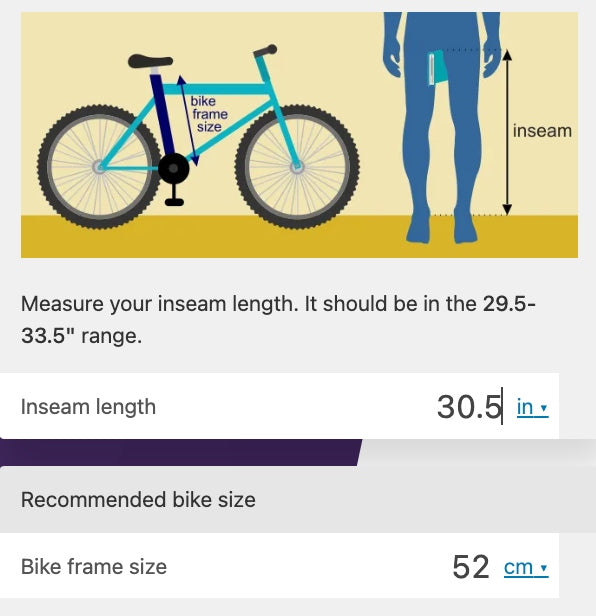 The Omni bike fit calculator is simple, and for me, fairly accurate.
One basic calculator that I found produced good results (for me) was the Omni Calculator. It gives good instructions on how to properly measure your inseam (your true inseam is NOT your pant inseam) and the calculator ended up picking the current frame size I ride. It also provides some other frame sizes options that can work. This is important, because most riders can actually fit a range of bike frame sizes, and sizing can vary depending on the manufacturer.
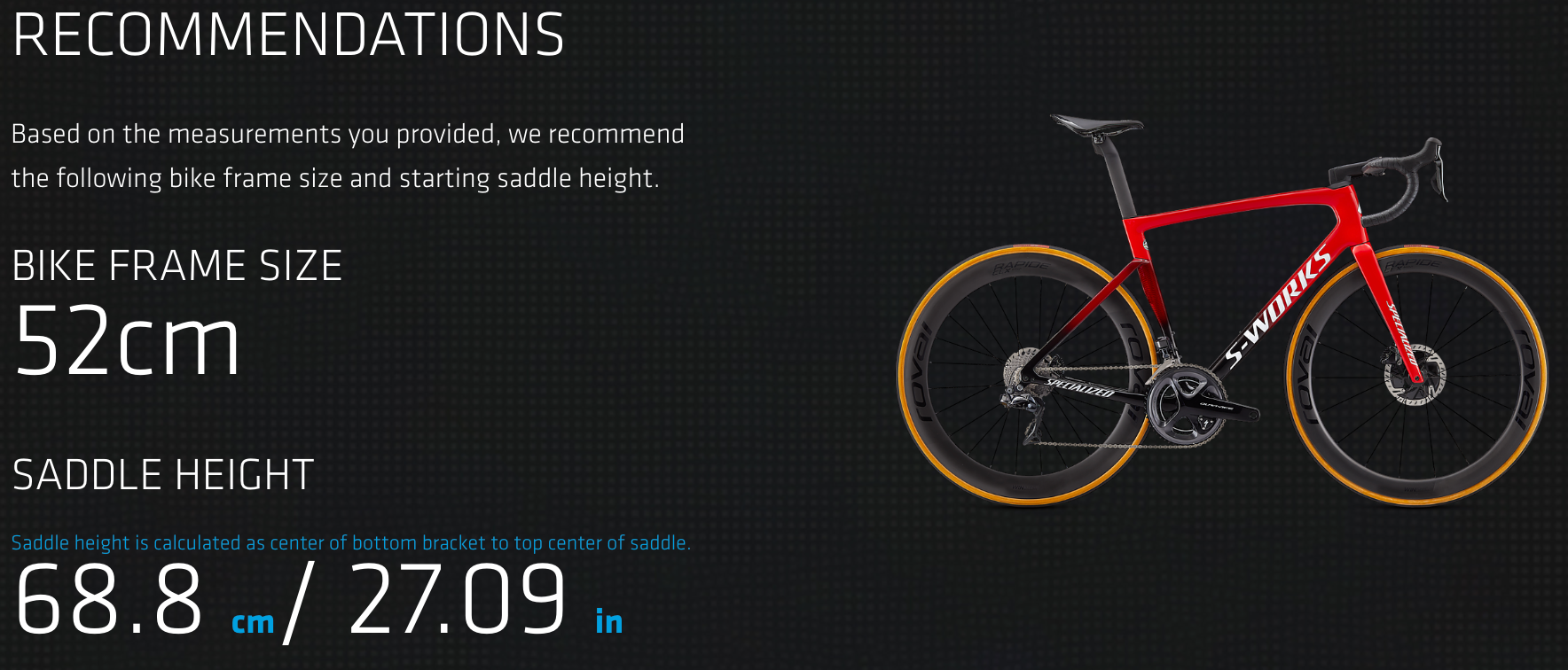 The Specialized / Retül calculator picked the correct frame size, but it also nailed my saddle height.
Omni was going to be my recommendation until I tried the Retül Fit App on the Specialized website. Unlike other sizing calculators, the Retül uses your height and shin length (it explains how to measure your shin in the App). Retül has collected fit data from tens of thousands of riders around the world. Just by using your height and shin length, it’s able to estimate your ideal frame size and saddle height.
For me, the results were shockingly good. It chose the frame size I generally ride, but more impressively, it provided a saddle height measurement within a few millimeters of the saddle height my Retül fitter landed at after my last in-person bike fit. This gives me a lot of confidence in this tool.
A few caveats: the recommended frame size is for a Specialized road/gravel bike and sizing can vary between brands, so keep that in mind. Also, that the saddle height recommendation is just a starting point. You will likely have to adjust it a bit higher or lower after actually riding it. Make sure you follow the instructions and measure your shin accurately too. I noticed that being off by half an inch would drastically affect the results.
Stack and Reach Calculator: Why These Numbers Matter
If you are comparing bike sizes online, stack and reach are two of the most useful geometry numbers to understand. A traditional frame size like 52cm, medium, or large can vary a lot between brands. Stack and reach make it easier to compare the actual fit of two different bikes.
Stack is the vertical height from the bottom bracket to the top of the head tube. More stack generally means a taller, more upright fit. Less stack generally means a lower, more aggressive fit.
Reach is the horizontal distance from the bottom bracket to the top of the head tube. More reach generally means a longer cockpit. Less reach generally means a shorter cockpit.
A stack and reach calculator can be helpful, but the most useful comparison is your current bike. If you already own a bike that fits well, write down its stack, reach, stem length, spacer height, handlebar reach, and saddle position. Then compare those numbers against the bike you want to buy.
For road and gravel bikes, stack and reach are especially helpful because two bikes with the same nominal size can feel completely different. A race road bike might have low stack and long reach. An endurance road bike or gravel bike might have higher stack and shorter reach, even if both are labeled the same size.
Road, Gravel & Mountain Bike Fit Calculators
Different bikes need different fit expectations. A road bike size calculator usually focuses on efficient pedaling, saddle height, cockpit length, and a comfortable drop-bar position. A gravel bike fit calculator should leave room for comfort and control on rough terrain. A mountain bike fit calculator should treat reach, stack, standover, and riding style differently than a road bike calculator.
| Bike Type | Most Useful Calculator Inputs | Fit Notes |
|---|---|---|
| Road Bike | Height, inseam, torso, arm length, flexibility, stack, reach | Road fit depends heavily on saddle height, reach to the bars, and saddle-to-bar drop. |
| Gravel Bike | Height, inseam, torso, arm length, stack, reach, bar width, riding style | Many riders prefer a slightly more upright gravel fit for comfort, stability, and control on rough surfaces. |
| Mountain Bike | Height, inseam, reach, stack, standover, riding style | MTB sizing is more style-dependent. Some riders size up for stability or size down for maneuverability. |
For mountain bikes, be extra careful with generic fit calculators. Modern MTB geometry changes quickly, and many riders can choose between two sizes depending on whether they want a more stable or more playful ride. Use the calculator as a starting point, then compare the specific geometry chart for the bike you want.
Finding the Best Online Bike Fit Calculator
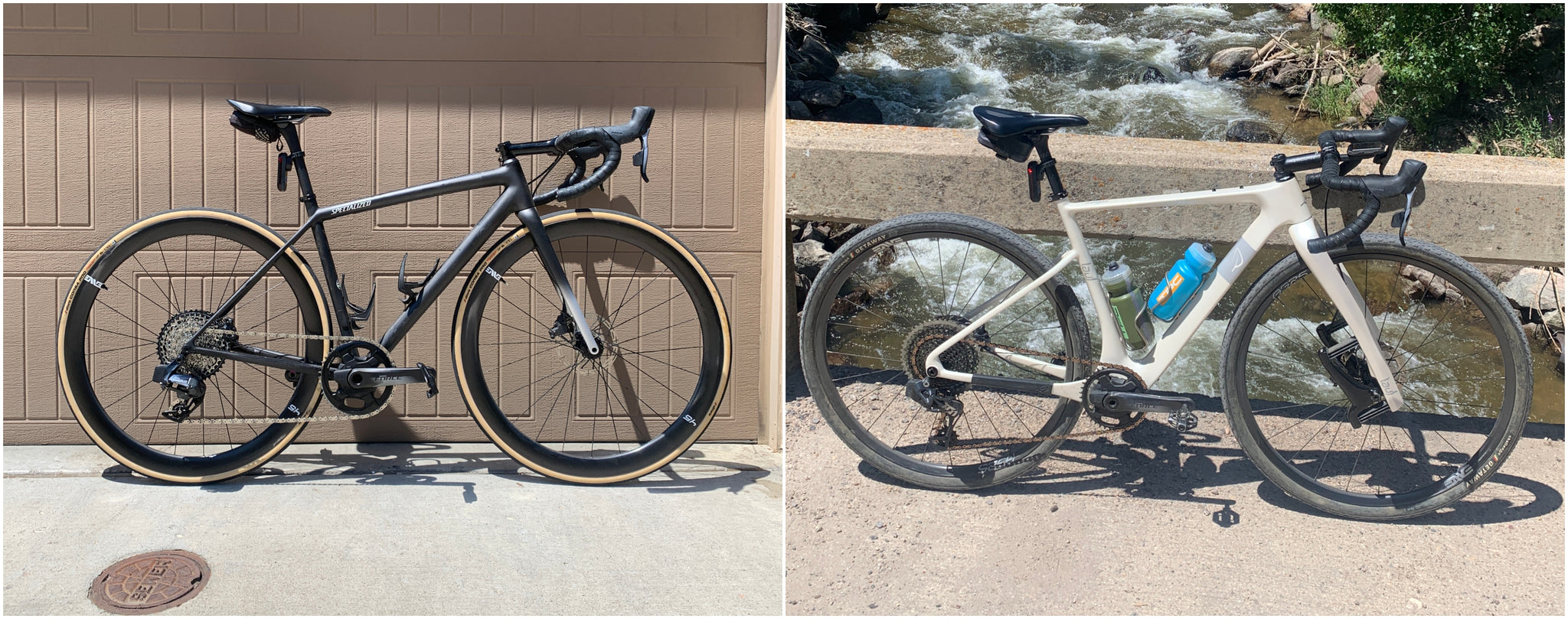 My current bikes are super comfortable and I'll be using them as reference points. The fit for both bikes has been refined over the last year with help from my Retül fitter.
If you’re getting more serious about cycling, then a professional bike fit is one of the best investments you can make. This goes beyond picking the right frame size or setting your saddle height. An actual professional bike fitter will help tweak your touch points (saddle, handles, pedals) and your riding position so that you're more comfortable and efficient. This will also help you prevent injuries or accommodate for any pre-existing injuries.
For years, my go-to for bike fitting has been Retül. I consider it to be the best in the business, but it can cost $300-500 depending on the fitter and any additional components (e.g., saddles, stems, or handlebars) you might need to purchase after the fit. As a result, not many riders actually get professionally fit because it can be too expensive or time-consuming.
This is where online fit calculators come in handy. Of course, there’s no way that an online calculator can achieve the accuracy or nuance you get from an actual in-person bike fit. But they can give riders a good starting point to dial in their bike fit at home.
Here are the three most popular online bike fit calculators that I tried:
Yes, these are all competitors of TPC. We don't offer anything similar, so it's what I have to work with.
All of these calculators use essentially the same measurements to determine your bike fit: height, sternal notch, inseam, torso, upper and lower arms, and upper and lower legs. They also give you options for how “aggressive” you want your fit to be, ranging from race-oriented to comfort-oriented.
My opinions on these calculators is based on how the results compare to my real-world road and gravel bikes and fit, which have all been dialed in over the last 15 years and refined with help from a professional bike fitter at Retül.
Here's a basic rundown of my numbers after my last Retül fit:
|
Height |
5’ 8.5” |
|
Inseam |
30.5” |
|
Current nominal bike size |
52cm / Small |
|
Current ETT |
531mm (road) / 544mm (gravel) |
|
Current reach |
380mm / 383mm |
|
Current stack |
527mm / 537mm |
|
Stem length |
120mm |
|
Bar width |
400mm |
|
Saddle height |
691mm |
|
Saddle setback |
72mm |
|
Saddle-to-bar drop |
91mm / 84mm |
|
Cockpit length |
560mm /555mm |
1st Place: The Wrench Science Fit System Calculator
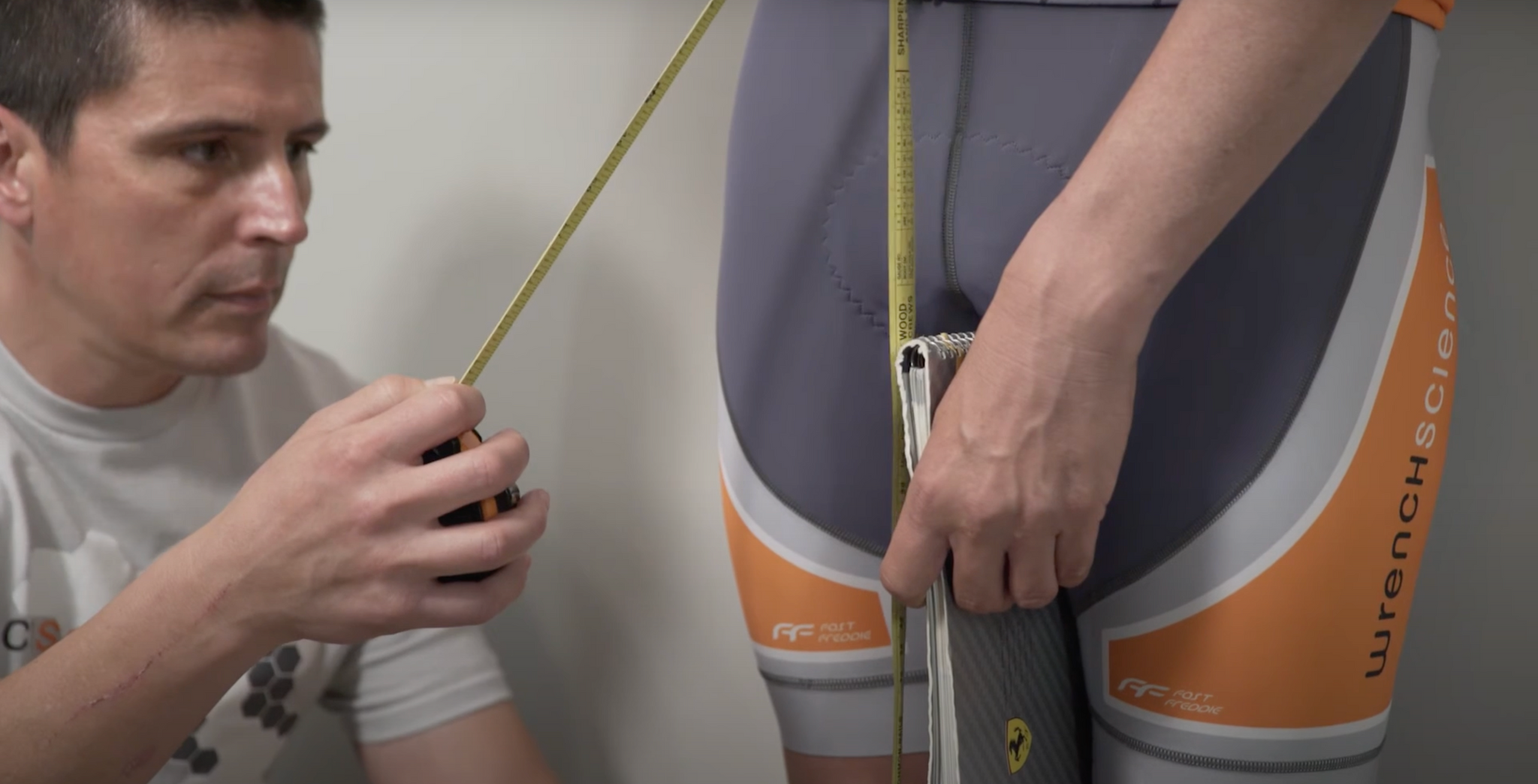 Wrench Science had the best demonstrations for how to take accurate measurements.
Wrench Science is my pick for the best calculator. There are a few reasons for this. First off, it adds shoulder width and most importantly, flexibility (which is easily measured using their flexibility chart) to its measurements to further refine its recommendations.
I also really appreciated that Wrench Science includes videos showing you how to take each measurement properly. Measuring accurately is the hardest part of using any of these calculators and I found the explanations on Competitive Cyclist and Jenson to be occasionally vague or confusing. I highly recommend having someone else help you measure yourself too. It makes it so much easier to get good, accurate measurements. The Wrench Science calculator also allows you to input decimals for your measurements.
Ultimately though, it’s the results that matter. Wrench Science won for me because it produced the results closest to my current road and gravel bike fit.
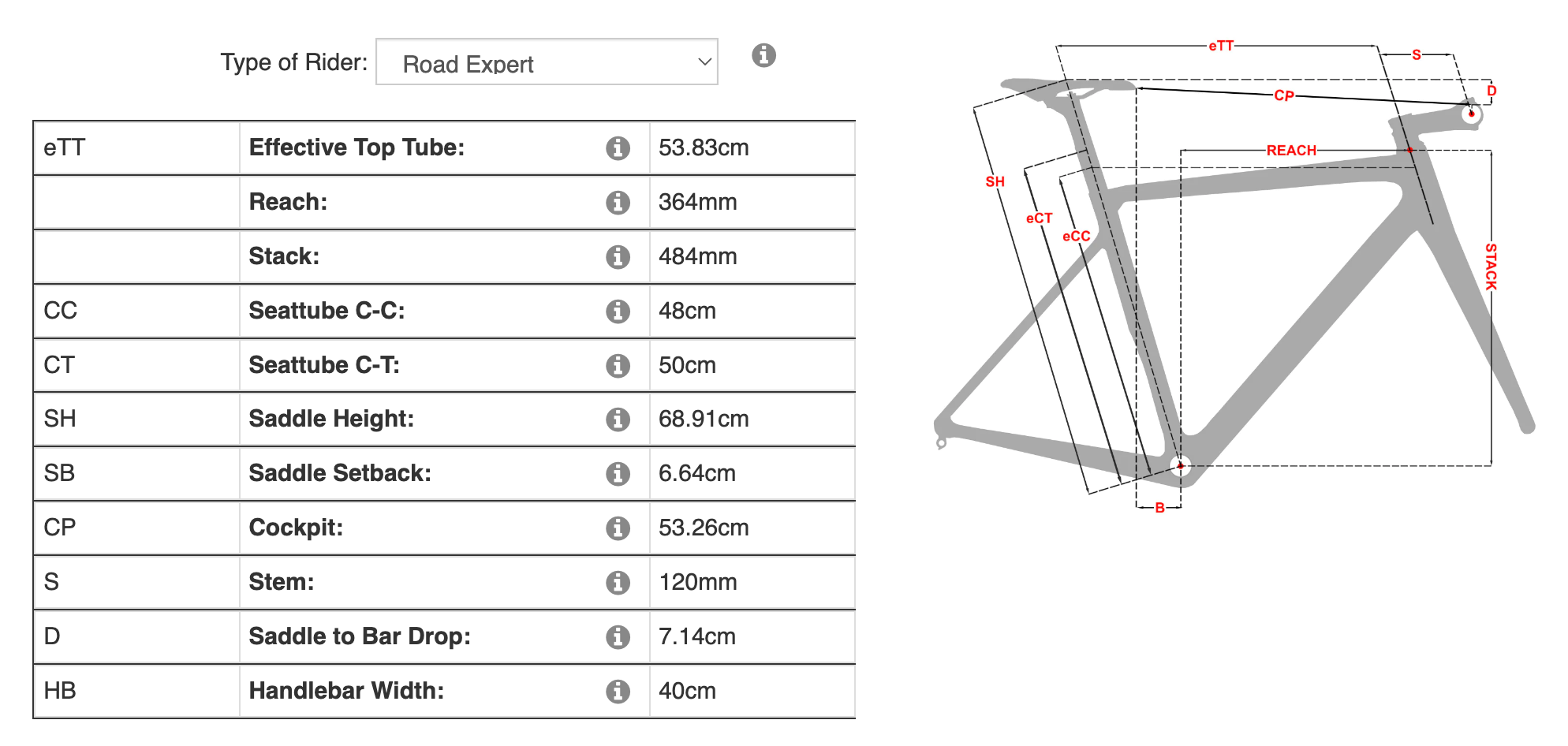 The Wrench Science Fit System calculator came very close to my Retül fit in several areas. I was very impressed.
Here is what the Wrench Science calculator nailed:
- Top tube length
- Saddle height
- Saddle set back
- Stem length
- Bar width
All of these measurements were either spot on or within 10mm of my current bike and fit measurements. It was the only calculator to suggest an effective top tube length and stem length close to what I actually ride. The saddle height and setback were also impressively close.
Here is what I considered misses:
- Frame stack
- Frame reach
- Cockpit (distance from saddle tip to bars)
- Saddle to bar drop
Of the four, the frame stack was the most egregious. It recommended a frame with a 484mm stack height, which is absurdly low. My current road frame has a stack height of 527mm, and I can probably only comfortably go 10-15mm lower. In fact, I’m not sure any bike in my size exists with a stack height that low, and if it did, I wouldn’t want to ride it. I remeasured and tested the calculator multiple times, using both inches and centimeters, and it seems like the stack height recommendation is just a wonky on the Wrench Science calculator, so I’d just ignore it.
Also, even though it picked my current stem length, the suggested frame reach is almost 20mm less than both of my current bikes, so I put that as a miss. As for saddle-to-bar drop, it's technically off, but I actually think for someone who doesn't want to run their cockpit as low and aggressive as me, it's probably a fine recommendation.
2nd Place: Competitive Cyclist Fit Calculator
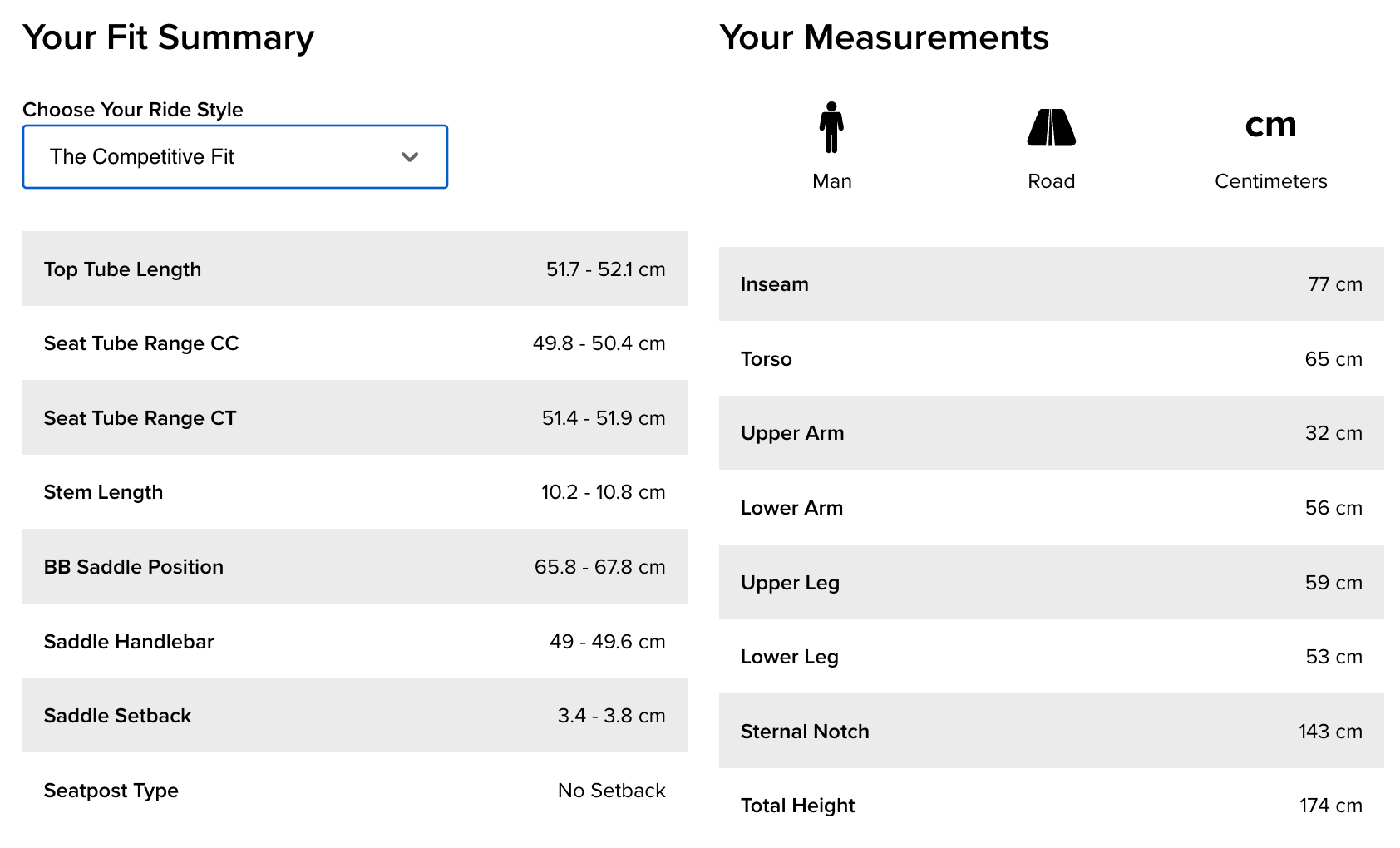 The closest to my current fit was the "competitive" fit option, but it's still pretty far off.
Of the three calculators listed here, the Competitive Cyclist’s fit calculator is probably the longest-standing and the most commonly referenced. It’s been around for at least 15 years or more. I remember using it way back in 2007 to set up my road bike. As far as I can tell, it's remained unchanged since then, which might not be a good thing.
The most annoying thing about this calculator is that you can't input decimals. So for important measurements like inseam, it puts me in a weird spot where I have to round up or down. I think this has to affect the results negatively. For example, the saddle height is quite off. If I round up, it's too high. Round down and it's too low.
The calculator also put me on a frame and stem combo that is much shorter than what I currently ride. I think this happened because the calculator doesn’t account for flexibility the way Wrench Science does. I have good hip mobility and hamstring flexibility and have been riding in long and low positions for over 10 years.
If I didn’t have my current flexibility, then the shorter frame and stem Competitive Cyclist recommends would probably feel more comfortable. In fact, when I took several months off after having my son, I had to temporarily shorten my stem 10mm because I lost some flexibility (and gained weight), so maybe it's more applicable if you lack flexibility or are searching for a more upright and comfortable fit.
Also, not that this should matter to recreational riders, but I found it interesting that the "Competitive" fit suggested a saddle setback that isn't technically UCI legal (50mm is the minimum).
Last Place: Jenson Bike Fit Calculator
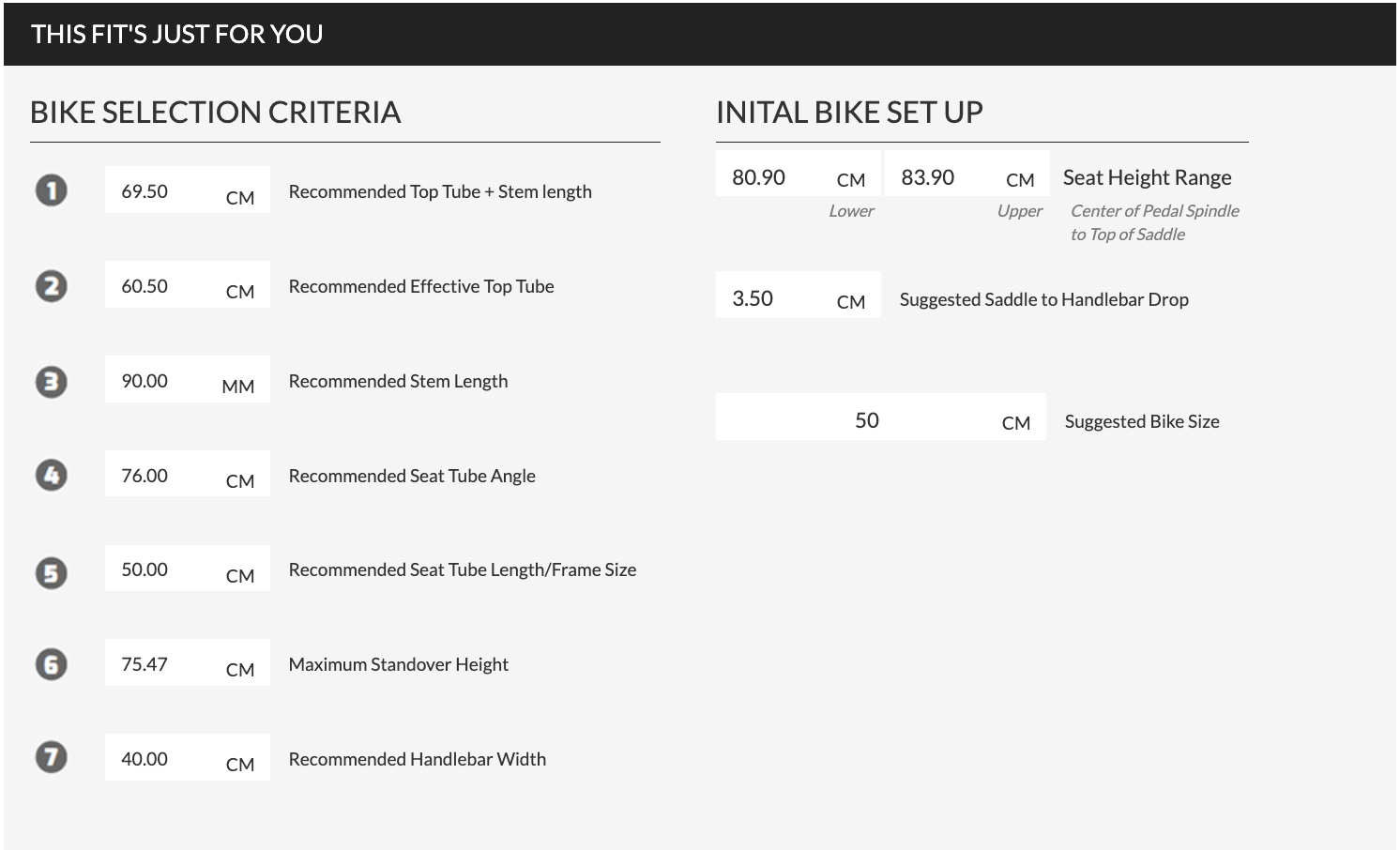 I couldn't make sense of how Jenson's calculator arrived at these wild numbers.
As for Jenson’s calculator. It was wildly off in nearly every measurement. The recommended top tube length and saddle height are both comically large, especially since it also suggested that I ride a much smaller 50cm frame (I generally ride a 52-54cm) with a 90mm stem, which didn't make any sense to me.
I remeasured and tested it multiple times and switched between inches and centimeters for my measurements. Every time it was just flat-out wrong. Overall, I was really confused with the results, so I wouldn’t recommend using Jenson’s calculator.
Bike Fit Calculator FAQ
What is the best bike fit calculator?
The best online bike fit calculator I tested was the Wrench Science Fit System because it gave the most realistic recommendations for my current road and gravel bike fit. For simple frame sizing and saddle height, the Specialized / Retül sizing tool was my favorite.
What is the best free bike fit calculator?
Wrench Science is my pick for the best free in-depth bike fit calculator. It asks for detailed body measurements and gives recommendations for top tube length, saddle height, saddle setback, stem length, bar width, stack, reach, and saddle-to-bar drop.
What is the best bike size calculator?
For basic bike sizing, I had the best results with the Specialized / Retül sizing tool. It gave me the correct frame size and a saddle height that was very close to my professional Retül fit.
Are online bike fit calculators accurate?
Online bike fit calculators can be accurate enough to give you a starting point, but they are not perfect. Measurement error, flexibility, riding style, injury history, and personal preference can all change your ideal fit.
Can a bike fit calculator replace a professional bike fit?
No. A bike fit calculator cannot fully replace a professional bike fit. It can help you set up a starting position, but an experienced fitter can watch you pedal, assess comfort, address pain, and make adjustments that a calculator cannot see.
What measurements do I need for a bike fit calculator?
Most bike fit calculators use some combination of height, inseam, torso length, arm length, leg length, shoulder width, flexibility, and riding style. More detailed calculators usually provide better results, but only if your measurements are accurate.
What is a stack and reach calculator?
A stack and reach calculator helps compare the fit of different bike frames using geometry numbers instead of generic frame sizes. Stack shows how tall the front of the bike is, while reach shows how long the frame is from the bottom bracket to the head tube.
How do I calculate bike reach?
Bike reach is a frame geometry measurement listed by most bike brands. If you are trying to compare your riding position, look at frame reach plus stem length, spacer height, handlebar reach, and saddle position. The frame reach number alone does not tell the whole story.
What is the best road bike size calculator?
The best road bike size calculator is one that uses more than just height. Inseam, shin length, torso length, flexibility, and riding style all matter. Specialized / Retül worked well for basic road and gravel sizing, while Wrench Science gave more detailed fit numbers.
What is the best mountain bike fit calculator?
Mountain bike fit calculators can give you a starting point, but MTB sizing is very dependent on riding style and modern geometry. Pay close attention to reach, stack, standover, wheelbase, and whether you want a more stable or more playful ride.
What is the best gravel bike fit calculator?
A good gravel bike fit calculator should help you find a comfortable position for mixed terrain. Many gravel riders prefer slightly more stack, a little less saddle-to-bar drop, and a position that balances efficiency with control on rough roads.
Final Thoughts
Based on my own test, the Wrench Science Fit System is the best free online fitting tool available. It’s easy to use and fairly accurate. I’ll provide this disclaimer though, I am a sample size of one. A different rider with different body proportions and riding needs might have very different results.
I have good flexibility and like a low and aggressive fit. I actually think both the Wrench Science and Competitive Cyclist calculators will probably work best for newer or more relaxed riders who want a fit that is slightly more upright.
Also, all of these calculators miss out on some other key bike fit elements that an actual in-person bike fitter can help you with:
- Saddle shape and width
- Saddle tilt
- Q-factor
- Crank length
- Cleat position
- Handlebar/shifter hood angle
- Aches and pains
That last point is a big one. Talking to an experienced and knowledgeable fitter who understands the human body can be a huge help if you're experiencing pain on your bike. My bike fitter helped cure my knee pain, and I'll keep going back to him because I trust him to keep me pain free.
Again, an online fit calculator should only be used as a starting point. You can use it to set up your initial stem length, bar height, and saddle position, and as you ride more and get more experienced, you’ll likely begin to understand what you need to tweak to improve your comfort and performance.
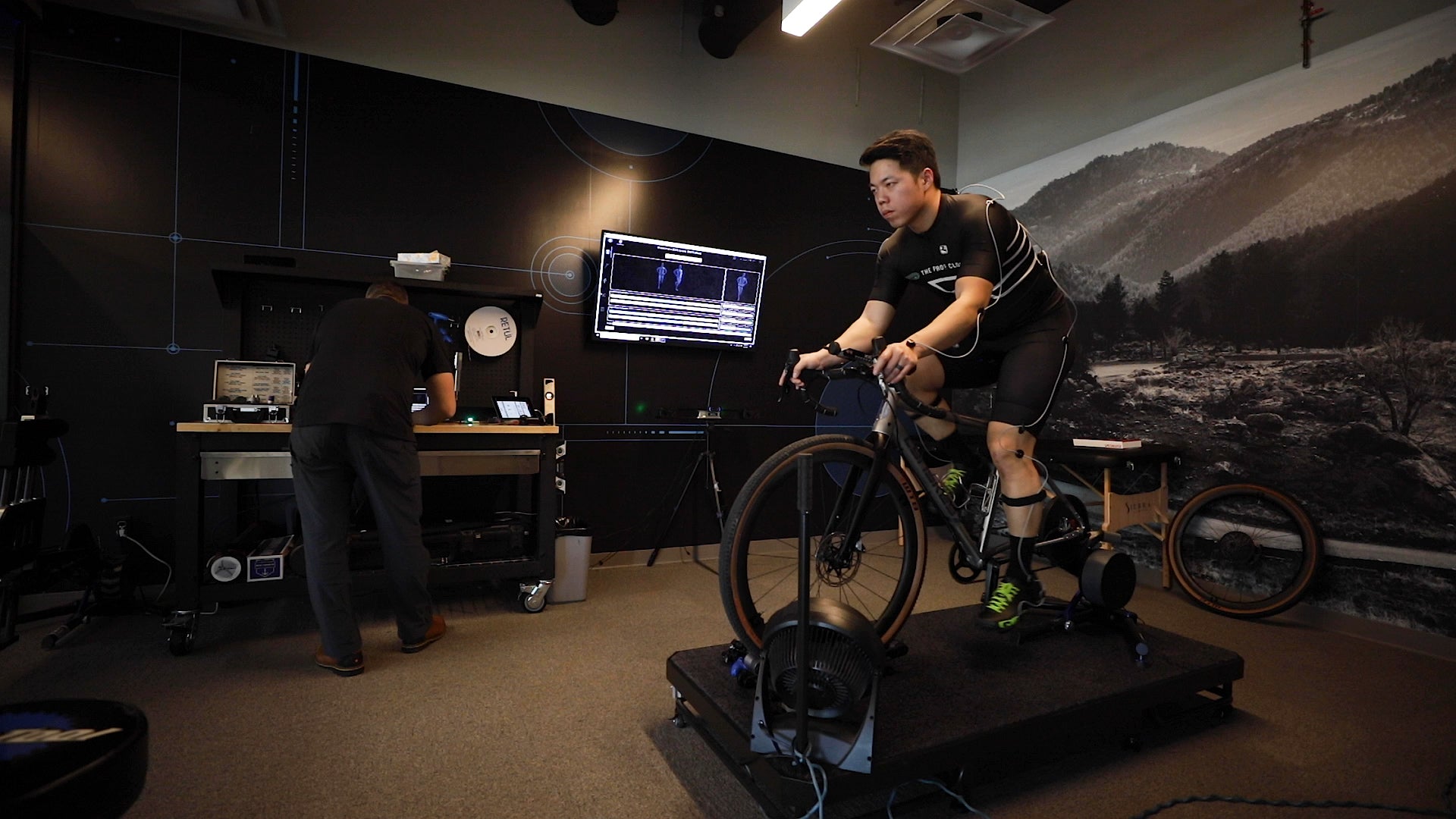 In-person professional bike fits are the next step.
If you find yourself struggling to get your bike to feel comfortable, however, then it’s probably time to visit a professional. I use Retül because I like the motion capture technology they use and I love that they provide a detailed "Fit Report" that can help you replicate your fit on multiple bikes (my most recent Fit Report is what I compared these online calculators against).
[button]Read About My Bike Fit Experience[/button]
There are fitters that will charge less than Retül, and really, any reputable fitter with enough experience should be able to get your riding position close to where it needs to be. I hope this write-up helped. Good luck tinkering with your bike! May you experience thousands of pain-free miles.
[button]Shop Bikes[/button]


